
Two pipes, two speeds
The hardest problem in live sports streaming is not latency. It is disagreement: between what your data already knows and what your viewer can actually see.
Every rights holder now runs two pipes out of the same venue. One carries video: encoded, segmented, pushed through a delivery network, reassembled in a player. The other carries data: a score, a card, a substitution, sent as a few hundred bytes to a web page. They do not travel at the same speed, and they are not close.
We measured both on a live match at the 2026 Canadian Rugby Championship. The data feed reached the page seconds behind the scorer. The video reached the viewer a long way behind it. Between those two numbers sits a window, about thirty seconds wide, in which the score is public and the try has not happened yet on anyone's screen.
The broadcast was spoiling itself.

A known failure, and it is getting worse
The industry has a name for it. The spoiler problem is consistently the top complaint from streaming sports audiences, and the usual description is a phone buzzing with a goal alert before the goal appears on the television. What is less often said is that the rights holder is frequently the one sending the alert. The scoreboard on your own match page, the live blog, the app widget, the betting overlay: these are self-inflicted.
It gets worse the better your data gets. Every improvement in live scoring widens the gap. A federation that upgrades from a volunteer typing into a spreadsheet to real-time officiating input has, without realising it, made its own broadcast worse.
Why buying faster video will not fix it
The standard response is to buy down video latency. Low-latency HLS, WebRTC, sub-second delivery: standard streaming runs ten to thirty seconds behind, low-latency around five to seven, ultra-low around one.
This is legitimate engineering and it works. But it carries an assumption that does not hold for most rights holders: that you control the whole path. We tested it ourselves, end to end, and measured what was actually delivered rather than what was configured. The two did not match, and the cause sat inside a piece of the chain we did not own and could not change.
For a provincial federation, this is the ordinary case. You do not own the encoder, the transcoder or the CDN. You can spend real money moving from thirty seconds to seven and still be seven seconds ahead of yourself. The gap narrows; it does not close.

The question to ask instead
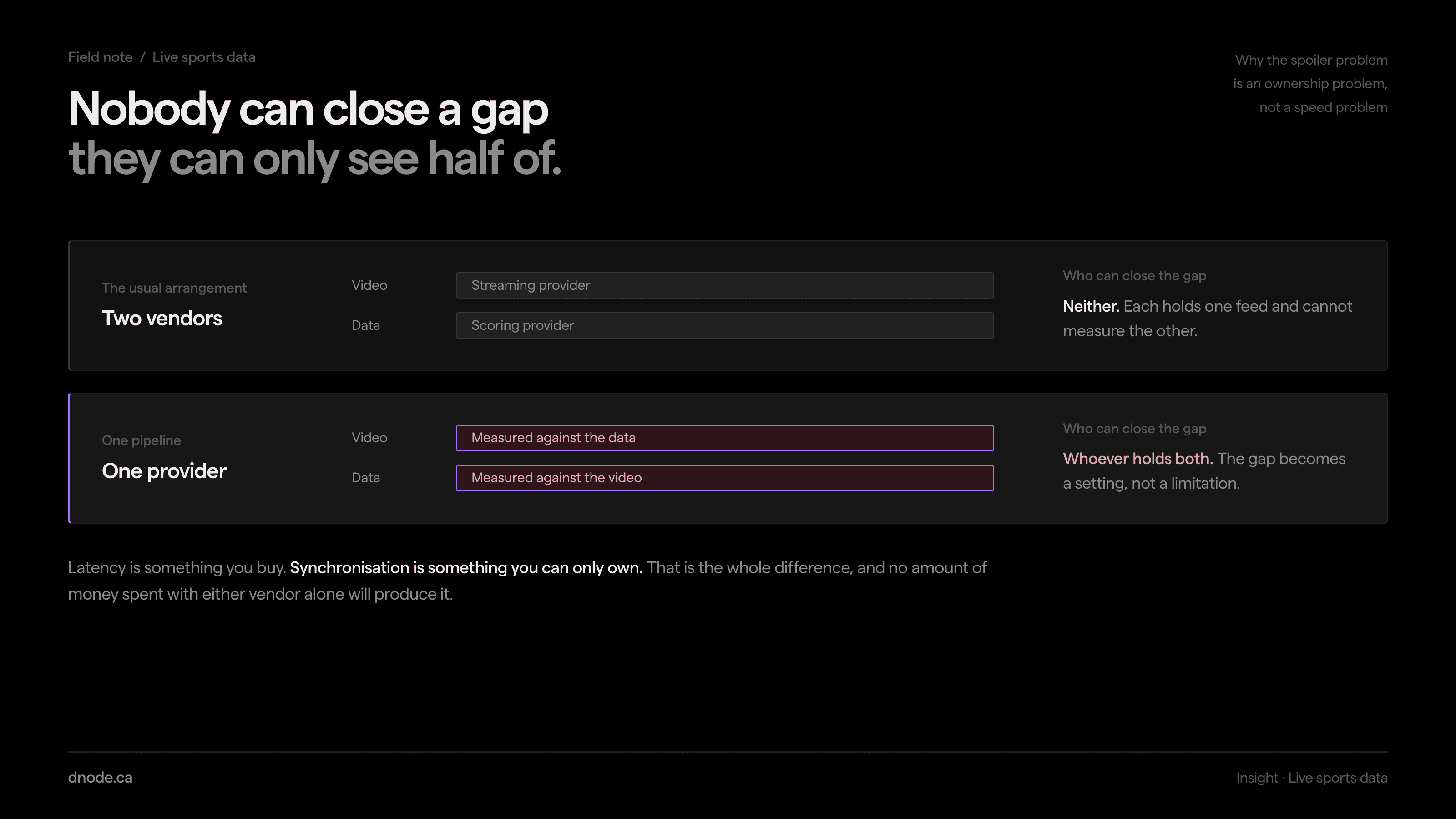
The gap exists because two things disagree, not because one of them is slow. That reframing matters, because it changes who can solve it. Latency is bought from vendors. Synchronisation can only be solved by whoever holds both feeds at once, and in most setups, nobody does.
So the useful question is not how fast is your stream. It is:
Has anyone measured the real gap at your venue? Glass-to-glass latency varies by venue, uplink and encoder. A number from a spec sheet is not a measurement, and a vendor who quotes one has not looked.
What happens on the surfaces you do not control? The match page is the easy one. The live blog, the app widget, the federation’s social account and the third-party scoreboard can all spoil your broadcast, and most plans account for none of them.
Does one party hold both the video and the data? If your stream comes from one vendor and your scoring from another, no one in the arrangement is able to close the gap, not because they are unwilling, but because neither can see both sides of it.
We can say this because we are on both sides of it. Our own crew shoots these matches and our own scorer records them, so the camera and the scoreboard leave the venue in the same hands. That is not a clever integration between two suppliers. It is the same people, and it is the only arrangement in which the gap is measurable at all.
The industry treats this as a transport problem because transport is what can be bought. Synchronisation cannot be bought from anybody, which is why it stays unsolved. It is an ownership problem. That is the argument for holding the whole path as one system rather than three purchases: scoring, graphics, streaming and the public record in the same hands. Not that it is tidier. A class of problem simply stops existing, and no amount of money spent on any single supplier makes it stop existing otherwise. The first step costs nothing: have somebody stand at your venue with a phone and a television and time the gap.
View more.

