
Two different things wearing the same word
Most people running a league channel believe the worst case is a muted video. That is the small one, and it is not the same mechanism.
A Content ID claim is automatic. A machine matches audio inside your upload against a reference file. The video stays up. It may be muted, blocked in some countries, or left running with the advertising revenue going to whoever filed the reference. It is an accounting event, and it is survivable.
A copyright strike is a legal instrument. A rights holder submits a takedown request against specific content, and the strike that follows attaches to the standing of the channel rather than to the video. Three active strikes can result in channel termination, which puts the entire archive attached to that channel at risk.
The distance between those two outcomes is the whole subject, and almost nobody inside a federation has been told there is a distance at all.

Live is judged while it is happening
Recorded uploads are checked after the fact. A live stream is checked as it goes out.
That matters at a venue, because a venue is full of music nobody cleared. The pre-match playlist over the public address. A walk-out track chosen by a seventeen year old. A goal horn. A sponsor sting cut to something recognisable. During a broadcast, a match can be muted, or cut, while it is still being played.
There is no appeal that runs faster than a second half.
Ninety days is a rolling job, not an amnesty
A strike expires after ninety days. Read quickly, that sounds generous.
Now put a fixture list next to it. Weekends through a season, several venues, several volunteers, several playlists nobody wrote down. Somebody has to know which strikes are currently active, file each dispute inside its window, and decide in advance what the walk-out music is allowed to be.
That is a job. It has a name, an owner and a calendar, or it does not exist. Most organisations discover it was a job on the weekend something disappears.
What is actually at stake
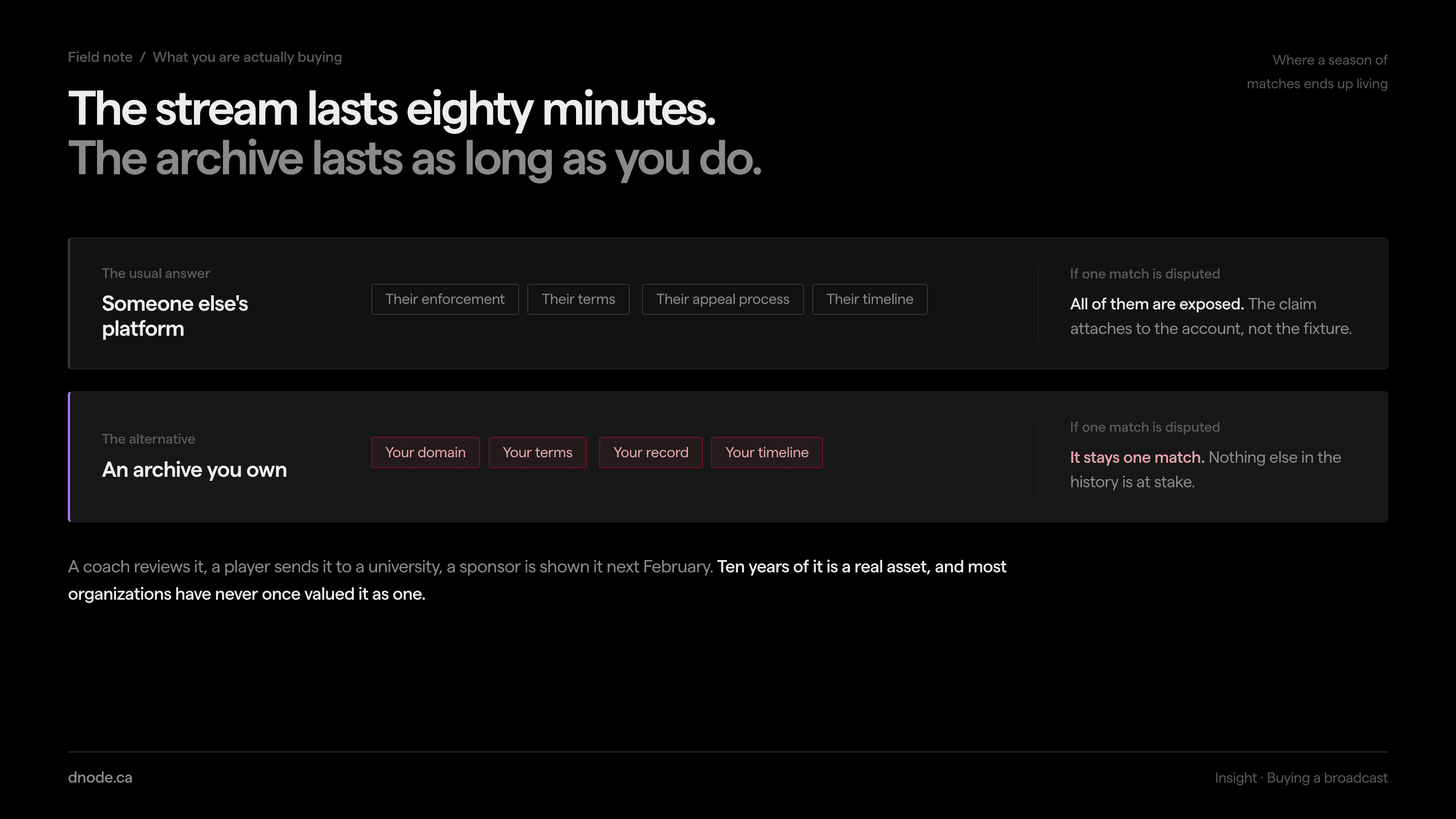
Federations think they are protecting a broadcast. They are protecting an archive.
The broadcast lasts eighty minutes. The recording lasts as long as the organisation does. It is what a coach reviews on the Tuesday, what a player sends to a university in the winter, what a sponsor is shown next February, and what the competition's own history is eventually made of.
A dispute over ninety seconds of music in one match is not contained to that match. It attaches to the account holding every match. That is the part almost nobody prices, because it never felt like a production decision. It felt like a hosting decision, made once, years ago, by somebody who has since left.

Three questions worth an hour before the season starts
Who is named when a claim arrives? Not who is careful. Who is named, in writing. If the answer is nobody, the answer is you.
Where does the archive live, and who can remove it? Then ask the harder version: if one match is disputed, what happens to the other four hundred.
What is the walk-out music allowed to be? If nobody at any venue can answer that in one sentence, the policy does not exist, and the season is being played on the assumption that nothing will be matched.
Where we stand
We publish our own broadcasts on our own service, so this risk sits with us rather than with the federations we work for. That is not a virtue. It is a structural choice, and it is the reason we know the mechanics well enough to write them down: we had to.
An organisation can reach the same position without us. What it cannot do is reach it by accident, and it cannot reach it in the week the claim arrives.
View more.

