Four records of the same match
Follow one match through an afternoon. A crew shoots it. Somebody delivers it to the people watching. Somebody keeps the statistics, usually on a system chosen years earlier for a different reason. Somebody runs the graphics on the broadcast and types the score in again to do it. That is four written records of the same match, kept by four parties who never sit down together, and every one of them is doing competent work. The problem is that nothing joins them. The video knows how long it is and nothing else. The statistics know who scored and have never seen the video. The graphics were right on screen and are gone the moment the broadcast ends. So the same match exists in four forms that disagree about it, and everything that would depend on those four agreeing is simply not on offer. It is not that those things are expensive. They cannot be bought at all.


One record, and everything else reads from it
This changes when one system holds the whole path, from the instant something happens in the match to every place it ends up.
The moment is recorded once, at the instant it is judged, and everything after that reads from the same record. What goes out on air reads from it. What the public site shows reads from it. What the archive keeps reads from it, and so does every answer the archive gives back to somebody who asks it a question years later. Nobody enters the score a second time, because there is no second place to enter it into. That sounds like an argument about tidiness and it is not one.
Four records that disagree is not an inconvenience you manage with more staff or a better camera. It is the reason a whole set of ordinary requests gets turned down.
What you can ask for once that is true
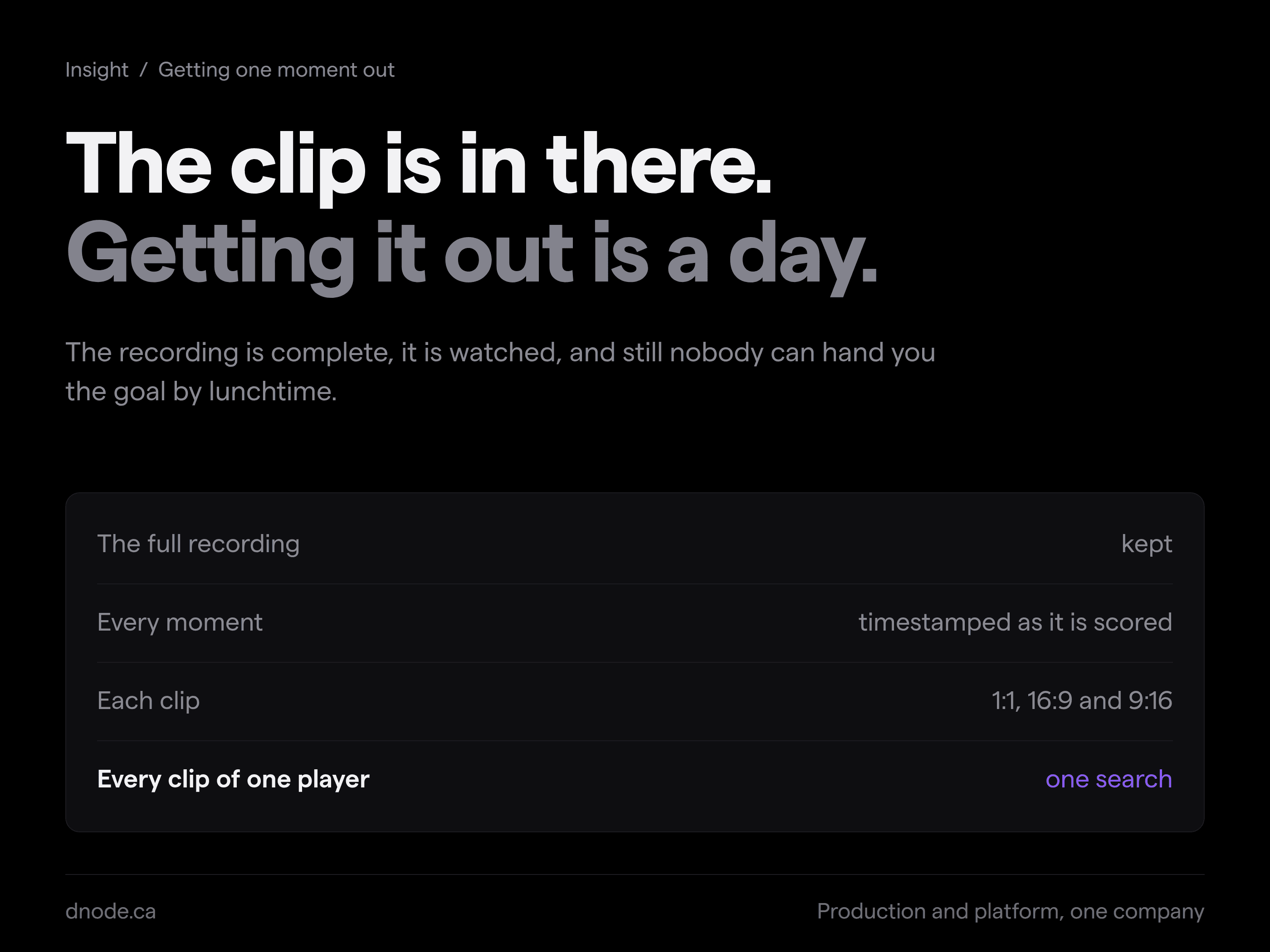
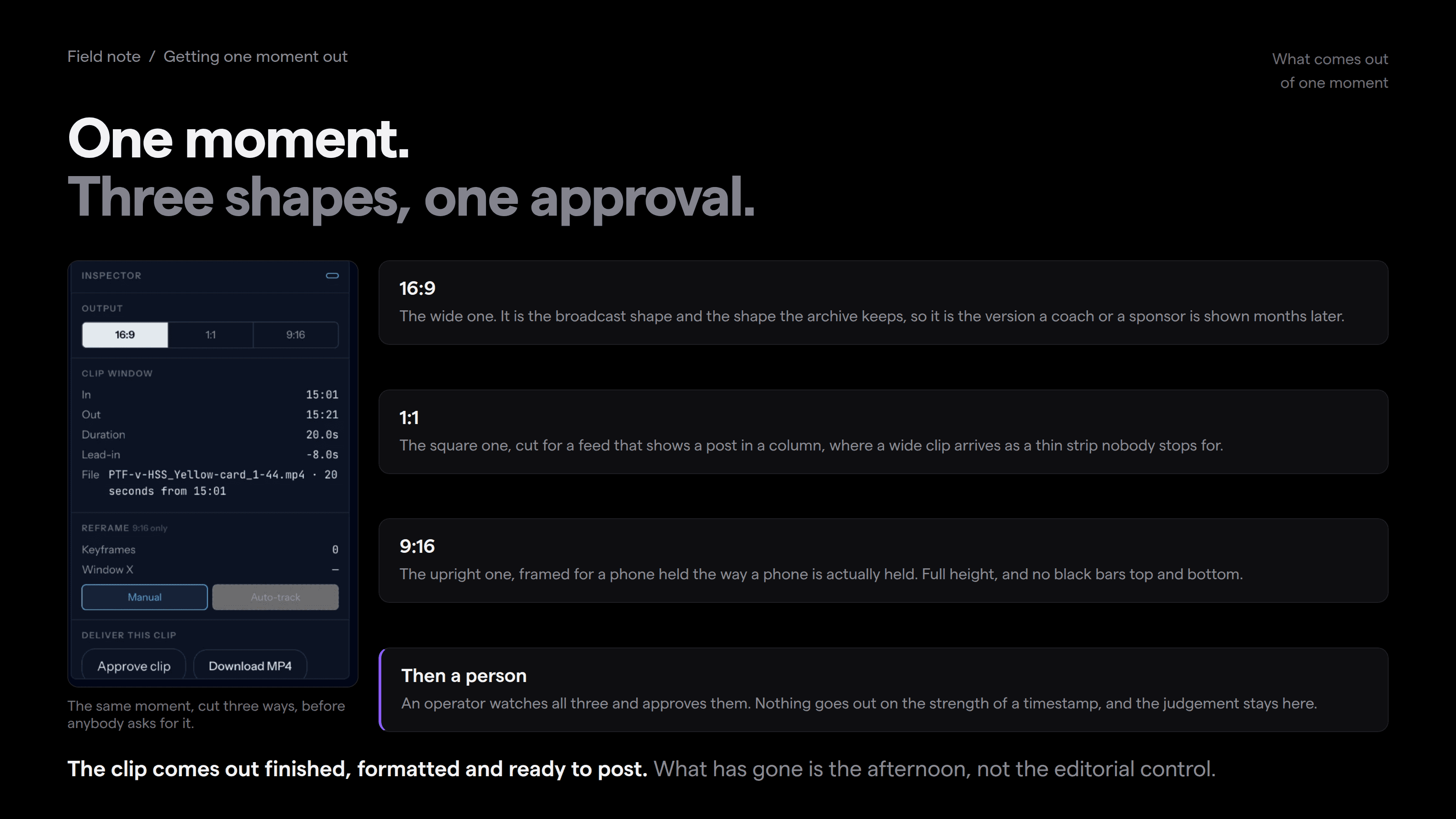
Things that were never on the menu become ordinary. You can ask the archive for a player rather than a time code and get back every moment they were part of, across every match they played. You can ask for a season, or for a whole championship, and have it come back as one film instead of a folder of recordings and a week of somebody's time.
The page showing the score stops spoiling the match for the people watching it, because one system knows what the page is about to say and where the picture has got to. And the permanent record of the competition stays with the competition rather than with whoever was hired to shoot it that year. That last one carries more weight than it first appears to.
On the 2026 U19 Canadian Rugby Championship, which we produced and published, 38.8 percent of all viewing happened after full time, on replays. The broadcast is over in an afternoon. The record is the thing people keep coming back to, and it is what an organization will still be using long after everyone has forgotten who held the camera.

The ceiling sits in the gaps, not in the budget
Live sport has been bought as a chain of separate suppliers for so long that the habit has stopped being visible. An organization runs one process for cameras, another for streaming, another for statistics, and assumes that what comes out of the three is a broadcast.
What comes out is three good pieces of work with gaps between them, and the ceiling on what that competition can do sits in the gaps rather than in anybody's budget or anybody's camera. A better camera does not move it. More people do not move it either, because the work being added is the work of carrying information across a gap by hand.
The companies that matter in the next stretch of this industry will be the ones holding the whole path, from the moment something happens to every surface it appears on. That is what we are building, and it is why we write the software our own broadcasts run on instead of buying it.
View more.

